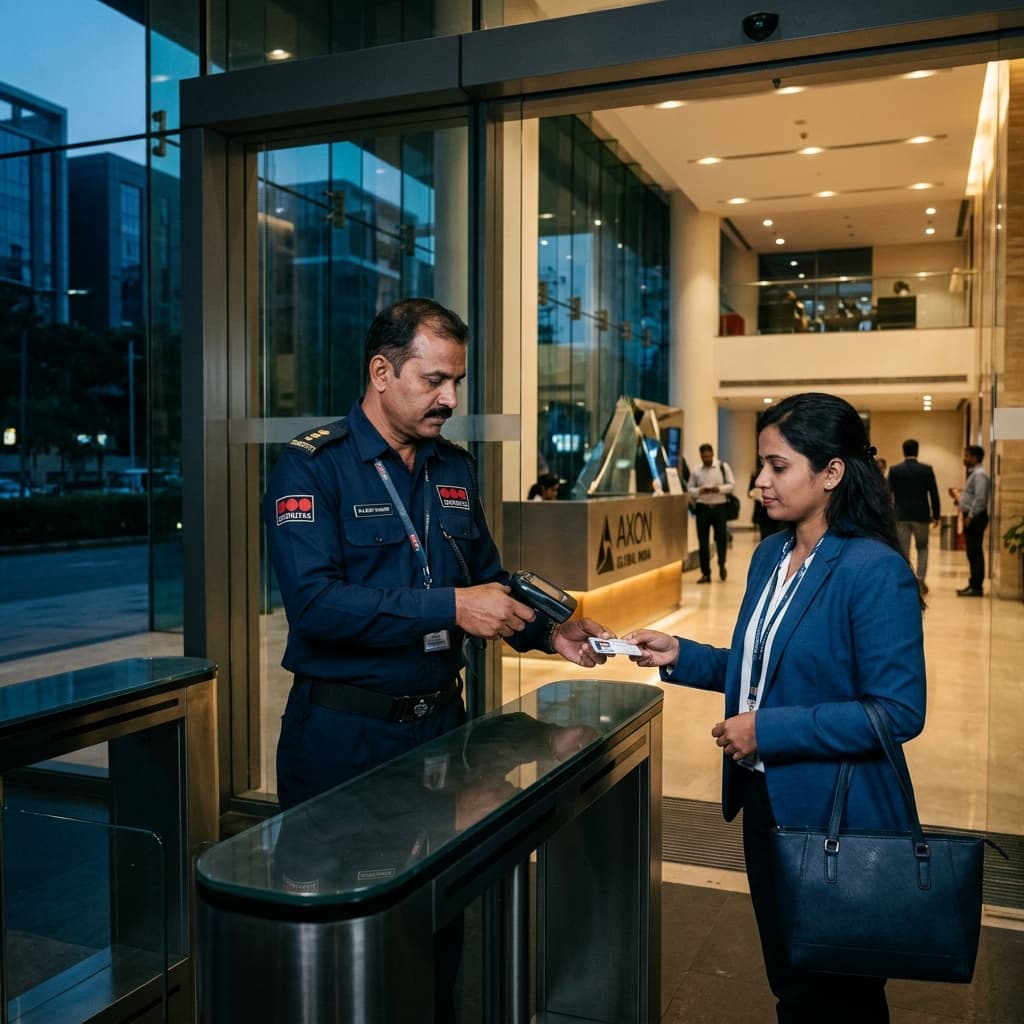
Office Security Audit Checklist
Reviewed by the Operations Team · Last updated Oct 1, 2026
The Short Answer
Audit five layers: entries (who can walk in), assets (what can walk out), procedures (what happens at open and close), people (who holds keys and alarms) and night cover (what protects the empty office). Most office breaches exploit the same gaps — unlogged visitors, shared keys, unwatched service entries and no closing routine. Walk the checklist below once a quarter and fix findings in priority order.
Layer 1: Entries and Access
List every way in: main door, service entries, basement links, terrace access, windows near ledges. Check who holds keys or codes, when codes were last changed, and whether visitors are logged or waved through. Test the entry yourself as a stranger — if you can reach the work floor unchallenged, so can anyone. Entry discipline and access-control support are core to /services/business-security deployments.
Layer 2: Assets and Information
Inventory what theft would hurt: cash and petty cash, laptops and devices, servers and backup drives, signed documents and client records, sample stock and display items. For each, note where it sits overnight and who can reach it. Server and record rooms need restricted access with a key log; devices need a sign-out register. Insurance inventories should match this list.
Layer 3: Procedures and People
Review opening and closing routines, key-holding lists, alarm codes and their change history, ex-employee access revocation, vendor and housekeeping supervision, and the incident reporting chain. Interview the guard and the receptionist separately — if their versions of the procedure differ, you have no procedure, only habits.
Office Audit Checklist Table
Check | Pass looks like | Fail looks like Visitor logging | Every stranger logged with purpose | Wave-through at reception Key control | Named holders + change log | Shared keys, unknown copies Service entries | Locked + logged use | Propped open for convenience Closing routine | Checklist signed nightly | Lights-out-and-hope Night cover | Manned or verified patrol | Empty building, no checks Incident chain | Named contacts displayed | Nobody knows who to call Score each line pass or fail, then fix fails starting with entries and night cover. Campus-scale audits with account management are covered under /services/enterprise-security.
Layer 4: Night and Weekend Cover
Empty offices are the real exposure. Verify shutter and lock checks, patrol frequency if guards are posted, alarm and sensor coverage of blind areas, and who responds to an alarm at 2 am. If the answer to the last question is nobody, that is your top finding regardless of everything else.
Testing Procedures Like an Intruder
Once a quarter, test your own office: walk in as a stranger and see how far you reach, try the service entry and terrace door, ask for a key you should not get, and call the displayed emergency number after hours to see who answers. Log every breach without blaming the guard on the spot — the failure is the procedure's, not the person's. Share results with the team and fix the procedure first; retraining follows the fix, not the other way round.
Fixing Findings in Priority Order
Fix entries before cameras, night cover before decor, and key control before everything cosmetic. Priority one: stop unchallenged stranger access and secure the empty building at night. Priority two: key and code control with ex-employee revocation. Priority three: registers, reporting chains and review rhythms. Budget-constrained offices should price priority one as a standalone phase — a guarded gate and verified night cover transform the risk profile even before the full program is funded.
Assigning Ownership for Every Finding
Every audit finding needs a named owner and a deadline: facility manager for locks and keys, IT for device registers, the guard supervisor for post discipline, HR for ex-employee revocation. Review open findings monthly until closed — audits without ownership become annual rituals that change nothing. File the audit with photos of each entry point and gate; next quarter's auditor compares against the file instead of starting blind. Ownership plus evidence is what turns a checklist into a security program.
Reception: the Office's Front Gate
Train reception as a security post, not just a welcome desk: challenge strangers politely, log every visitor with purpose and host name, hold deliveries at the desk instead of waving riders to floors, and never announce who is in which cabin to unknown callers. The receptionist and the guard should run one shared procedure — interview them separately during audits, because differing versions mean the procedure exists only on paper.
Key Takeaways
One: audit entries, assets, procedures, people and night cover. Two: test entries as a stranger. Three: mismatched staff versions of a procedure mean no procedure. Four: fix entries and night cover first. Five: repeat quarterly — offices drift.
This briefing is brought to you by Defensary Alpha Security Services — Lucknow's premier security agency.

Need Expert Security Advice?
Contact Defensary Alpha for a free consultation and security assessment tailored to your needs.
Schedule Consultation