Festival and Crowd Safety Planning in Lucknow
Reviewed by the Operations Team · Last updated Sep 28, 2026
The Short Answer
Safe crowds come from arithmetic, not luck: entry capacity per gate, parking sized to vehicles, vendor zones separated from guest flow, an emergency lane that stays empty, and a dispersal plan for closing time. Lucknow's festival calendar — weddings, baraats, religious processions, fair grounds — concentrates all five problems at once. Plan each on paper before the first guest arrives.
Entries: Count the Flow, Not the Guests
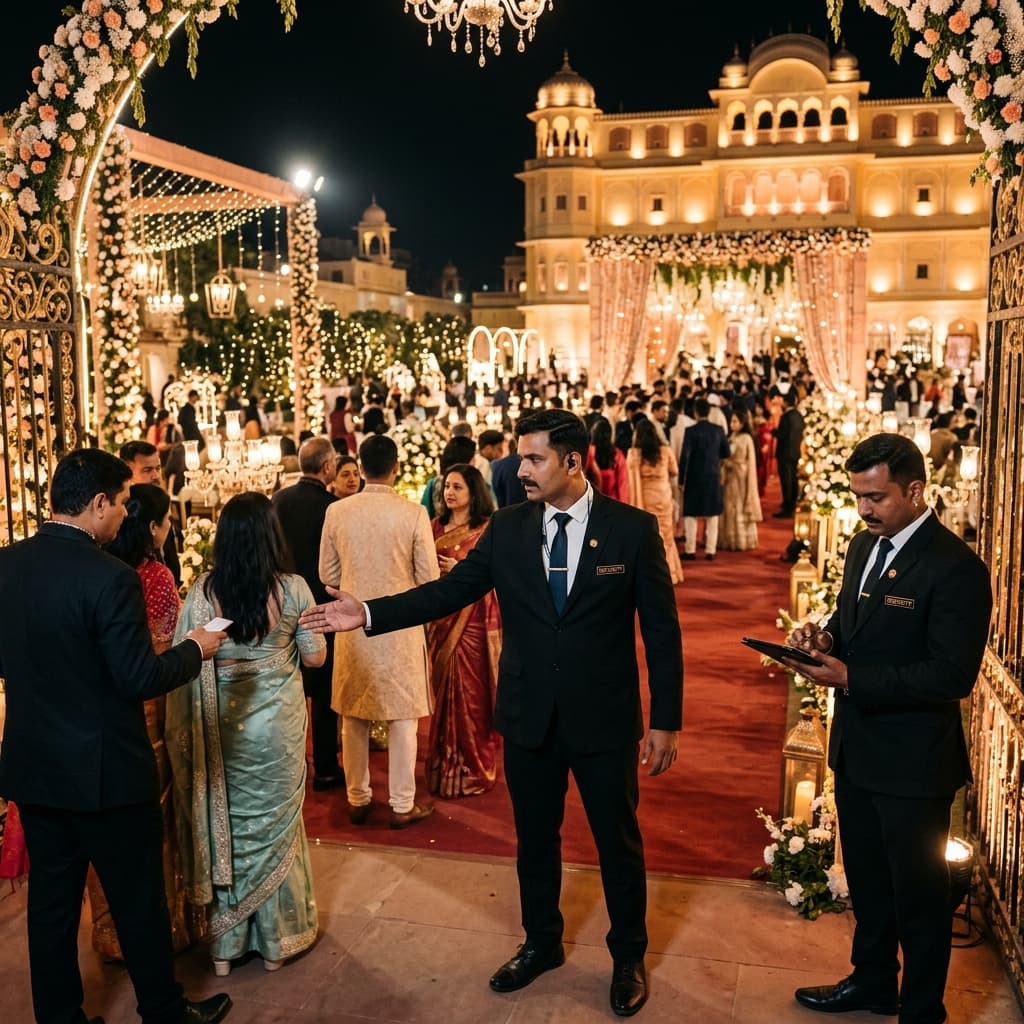
A gate passes a fixed number of people per minute; divide expected arrivals by that rate and you get your gate count and opening time. Tier entries — family, general guest, vendor, VIP — so one choked gate never stops the whole event. Baraat entries need their own plan: dancing crowds compress at doors, so hold a buffer zone with barriers and post your strongest team there. Entry and tier design is core to /services/event-security planning.
Parking, Vendors and the Emergency Lane
Parking demand always exceeds the venue's own space — stage overflow plots in advance with shuttle or walking lanes, and never let parking colonize the emergency lane. Vendors get one entry, time-bound passes and a setup window before guests arrive; wandering vendor staff is how backstage zones leak. The emergency lane runs from the main gathering point to the nearest road exit and stays empty all function — mark it, brief it, guard it.
Function-Wise Safety Checklist
Function | Key risks | Cover Baraat arrival | Door compression, road blockage | Buffer barriers + road traffic hands Main ceremony | Crowd density at stage | Stage perimeter + density watch Dinner service | Buffet crush, queue jumping | Queue lanes + buffet-side team Farewell / dispersal | Dark exits, vehicle chaos | Lit exits + staged vehicle release Night functions | Fatigue, intoxication, thin cover | Fresh night team, no doubled shifts Close-protection needs for attending dignitaries layer on top — see /services/pso-services.
Medical, Fire and Communication Basics
Keep a first-aid point with a trained attendant, know the nearest hospital route, check fire-extinguisher placement at food and electrical zones, and run the whole team on one radio net under a single commander. Brief the local police post for large public gatherings — permissions and liaison prevent last-minute shutdowns.
Baraat Planning in Detail
The baraat is Lucknow's signature crowd problem: a dancing procession on public roads converging on a venue gate with hundreds of guests. Plan the route with the venue and traffic police, fix dance-halt points so the procession does not stall at narrow turns, post road-hands ahead and behind the procession, and hold the venue gate buffer until the family entry moment. Fireworks and band equipment need their own safety spacing. A baraat that arrives in order sets the tone for the entire function.
Permissions and Police Liaison
Public processions, loudspeaker use, road usage and large gatherings need permissions — applied for in advance with route maps, timings and organizer contacts. Share your security plan summary with the local police post: entry tiers, crowd estimates, VIP movements and the commander's contact. Liaison does not replace your own team, but it buys faster response if anything exceeds private capacity, and it keeps the event on the right side of shutdown risk.
Weather, Power and Contingency Planning
Open-air functions live or die on contingencies: rain backup for electricals and seating, generator capacity for the full load with fuel for the whole function, wind-rated anchoring for stages and pandals, and a medical point for heat, dehydration and crowd injuries. Brief the team on the rain plan and the power-failure drill — crowds stay calm when staff visibly know what to do, and panic when they do not.
Religious Processions and Fair Grounds
Lucknow's religious processions and mela grounds add route-length complexity: kilometres of moving crowd rather than one venue. Plan march order with organizers, post route marshals at turns and bottlenecks, keep emergency vehicle pockets at intervals along the route, and coordinate drinking-water and first-aid points with volunteers. End-point dispersal needs the same gate-and-parking discipline as a wedding venue — most procession incidents happen at the tired, crowded finish, not the energetic start.
Post-Function Review
Debrief every function within a week: attendance handled versus planned, gates that choked, dispersal timing, incidents and vendor compliance. File guest-list records and handover receipts for the season. Share a short summary with hosts covering crowds managed and timings met — documented success converts one function into the family's next booking and the venue's recommendation.
Key Takeaways
One: size gates from flow rates, not guesses. Two: stage parking before guests arrive. Three: one vendor entry with time-bound passes. Four: an emergency lane that stays empty is non-negotiable. Five: plan dispersal with the same care as arrival.
This briefing is brought to you by Defensary Alpha Security Services — Lucknow's premier security agency.
Need Expert Security Advice?
Contact Defensary Alpha for a free consultation and security assessment tailored to your needs.
Schedule Consultation